

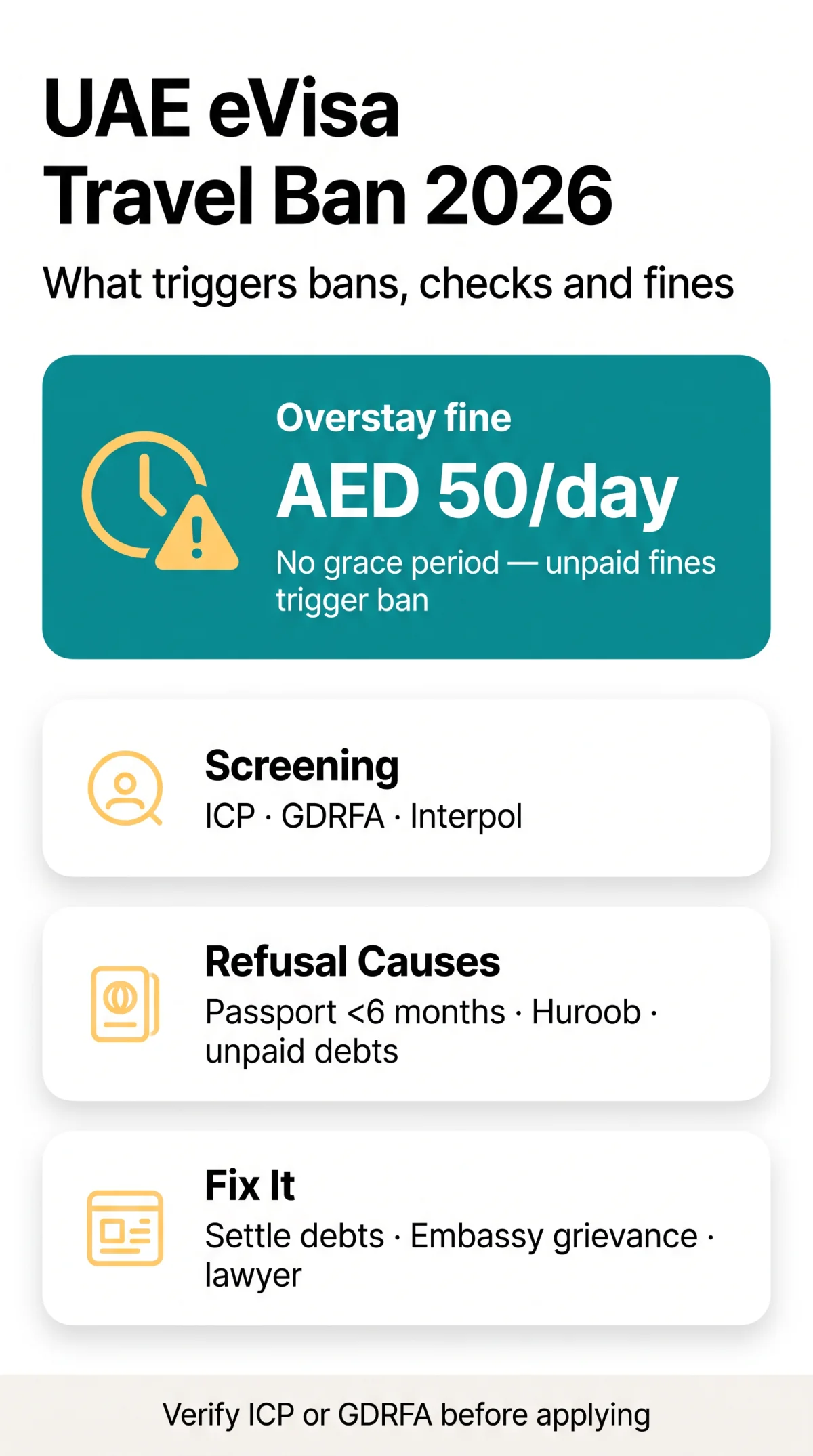
A UAE eVisa travel ban blocks approval by flagging applicants through ICP immigration databases, Interpol records, and GDRFA entry logs. Overstay fines accrue at AED 50 per day with no grace period for tourist eVisas, escalating into automatic bans. UK passport holders do not need a police certificate for tourist eVisas, but screened flags cause refusal.
Featured Snippet: A UAE travel ban can prevent your eVisa from being approved. The UAE screens applicants through ICP databases, Interpol records, and immigration history. Overstay fines (AED 50/day), criminal records, and financial disputes can trigger a ban. UK tourists do not need a police certificate for tourist eVisas, but flagged applications face refusal. Check your status at or GDRFA before applying.
What Causes a UAE Travel Ban?
A UAE eVisa travel ban originates from judicial court orders, unpaid financial debts, immigration overstay records, or security flags registered in ICP and GDRFA federal systems.
Country-wide restrictions also apply; for example, visas for the DRC, Uganda, and South Sudan are suspended from 13:00 on 6 June 2026 due to Ebola precautions. Additionally, FCDO 2026 travel advice warns of regional disruptions due to US-Iran tensions, though this does not constitute a personal UAE eVisa travel ban.
| Ban Type | Who Imposes It | What It Prevents | How to Check | How to Resolve |
|---|---|---|---|---|
| Exit Ban (Financial/Court) | Dubai Police / Courts | Leaving the UAE (unpaid debts, bounced cheques) | Dubai Police App | Settle debts, engage lawyer |
| Entry Ban (Immigration/Security) | ICP / GDRFA | Entering the UAE (overstays, deportation) | ICP Smart Services | Submit grievance via Embassy |
How UAE Overstay Fines Can Trigger a Travel Ban
Overstaying a UAE tourist visa (valid for up to 90 days) incurs AED 50 per day from day one with no grace period, and unpaid fines escalate into deportation and an automatic UAE eVisa travel ban.
According to the UAE Federal Authority for Identity, Citizenship, Customs & Port Security (ICP) circular No. 2025-03, the 30-day grace period for tourist visa overstays was eliminated effective 1 January 2026. Settling overstay fines at the airport still requires a mandatory exit pass (out-pass) to legally depart. Unpaid fines trigger a permanent UAE eVisa travel ban.
- If you overstay 1 day, your fine is AED 50.
- If you overstay 14 days, your fine is approximately AED 700.
- If you overstay 30 days, your fine is approximately AED 1,500 (high risk of deportation and entry ban).
UAE eVisa Background Checks, Criminal Record Screening & Refusal Reasons
UAE eVisa screening runs applicants through ICP federal databases, GDRFA records, and Interpol flags – but UK tourists do not need a police clearance certificate for standard tourist eVisas.
The automated background check pipeline dictates whether a UAE eVisa travel ban blocks your application:
- ICP Database Query: Checks for federal immigration violations and active Huroob (absconding) reports.
- GDRFA Records Check: Verifies Dubai-specific residency and past overstays.
- Interpol Screening: Flags international criminal records or security notices.
While nationalities like Bangladesh, Pakistan, and Lebanon face normal processing with heavy security screening, UK citizens face refusal primarily for specific triggers. A UAE eVisa travel ban or visa refusal occurs due to:
- Passport validity under 6 months after the arrival date.
- Active Huroob (absconding) reports.
- Documentation fraud or prior deportations.
- Unpaid financial debts or bounced cheques.
How to Check If You Have a UAE Travel Ban
UK travellers can verify a UAE eVisa travel ban status through ICP Smart Services at, the GDRFA Dubai portal, or the Dubai Police app using a passport number.
If online databases show clear records but entry issues persist, contact the UAE Embassy in London for manual preliminary checks to uncover any hidden UAE eVisa travel ban.
| Portal | What It Checks | What You Need to Input | What the Result Tells You |
|---|---|---|---|
| ICP Smart Services | Federal immigration records | Passport number, nationality | Visa eligibility and active entry bans |
| GDRFA Dubai (gdrfad.gov.ae) | Dubai-specific residency | Passport number, name | Dubai visa status and overstay flags |
| Dubai Police (dubaipolice.gov.ae) | Financial cases circulars | Emirates ID or Passport | Active exit bans for unpaid debts |
How to Appeal or Remove a UAE Travel Ban
Removing a UAE eVisa travel ban requires verifying the ban type via ICP Smart Services, settling any outstanding debts, and submitting a formal grievance – UK residents can initiate the process remotely through the UAE Embassy in London.
In our work with UK travellers, we’ve seen cases where unpaid overstay fines as low as AED 1,500 led to automatic entry bans. One client cleared a financial dispute through the Dubai Police portal and successfully appealed within 3 weeks. Permanent biometric (iris/fingerprint) blacklisting ensures obtaining a new UK passport cannot bypass a UAE eVisa travel ban.
Verify status
Check federal portals (ICP/GDRFA) to confirm the ban type.
Settle debt
Clear any unpaid financial claims or bounced cheques.
Contact ICP
Address immigration-specific entry bans directly.
Engage a lawyer
Hire UAE-based legal representation for court-imposed exit bans.
Submit grievance
Lodge a formal appeal via the UAE Embassy in London.
Frequently Asked Questions (FAQ)
Does a UAE travel ban from another country affect my eVisa application?
Yes. The system queries Interpol records alongside federal ICP databases. If another country issues a severe criminal or security flag through Interpol, it triggers an automatic visa refusal during preliminary checks.
Can I get a UAE eVisa if I have a UK criminal conviction?
UK tourists do not need a police clearance certificate for a standard tourist eVisa in 2026. Minor UK convictions might not block your application unless they flag you in international databases like Interpol.
How do I disclose a travel ban or criminal record on my eVisa application?
Standard applications do not require manual disclosure of minor records. The UAE relies on automated background checks through ICP and GDRFA. Active bans are detected automatically, resulting in rejection.
What is the difference between a travel ban and an overstay fine?
An overstay fine is a financial penalty of AED 50 per day starting immediately after visa expiry. A travel ban is a formal restriction preventing entry or exit. Unpaid fines escalate into permanent immigration bans.
How long does a UAE travel ban last?
Duration depends on the cause. Bans for severe security flags, deportation, or Huroob reports are often permanent, enforced via biometric blacklisting. Financial bans remain active until debts are settled and appealed.
Can I transit through Dubai if I have a UAE travel ban?
No. If you have an active entry ban in the ICP or GDRFA systems, you cannot transit. Security systems use permanent biometric tracking, flagging you during transit screening even with a new passport.
Will paying my overstay fine automatically remove my travel ban?
No. After settling the fine, you must obtain a mandatory exit pass to leave the airport. To fully remove an immigration ban, you must submit a formal grievance through the UAE Embassy in London.
Does the UAE share travel ban information with the UK government?
The UAE does not routinely share standard overstay or financial ban details with the UK. However, severe criminal cases are shared internationally via Interpol records. Verify your status independently using ICP Smart Services.
Can I apply for a different type of UAE visa if my tourist eVisa is refused?
If refused due to an active ban, applying for a different visa type (like transit or work) will also fail. You must clear the underlying immigration or financial restriction before submitting any new application.
What should I do if my eVisa is rejected due to a background flag?
First, verify the exact cause using the ICP Smart Services or Dubai Police portal. Settle any outstanding fines or debts, then submit a formal grievance through the UAE Embassy in London to lift the restriction.
Last updated: 18 September 2026. This article is for informational purposes only and does not constitute legal advice. Always verify your status through UAE government portals before applying.